

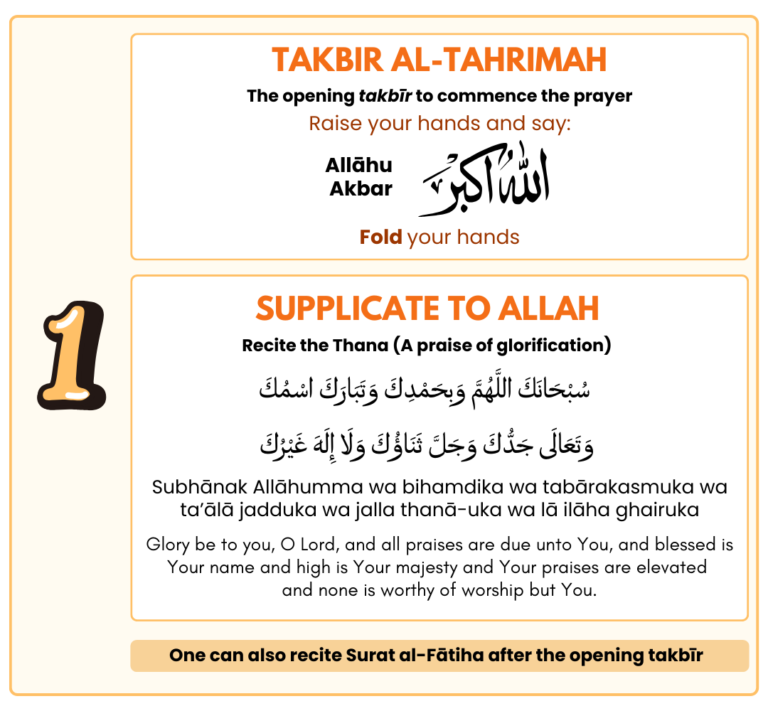
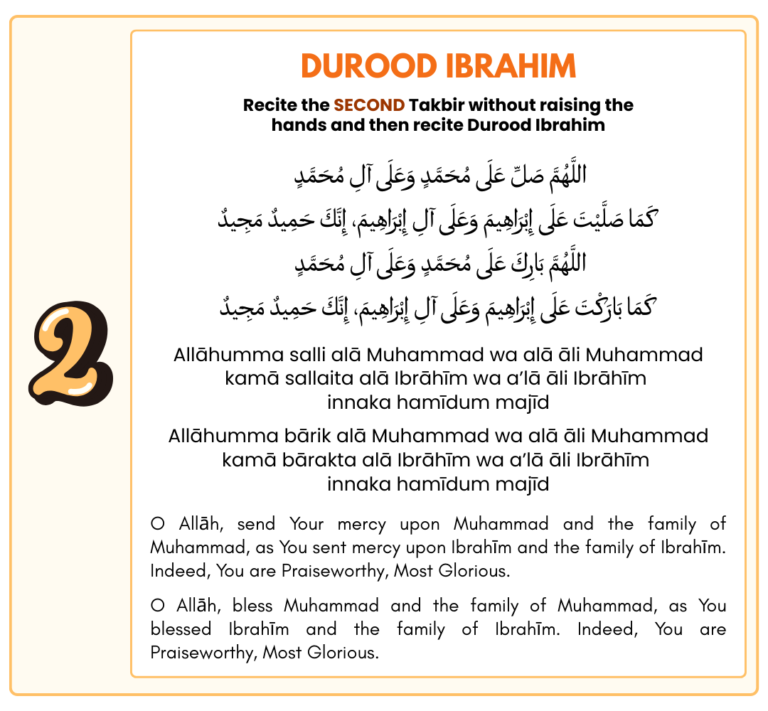
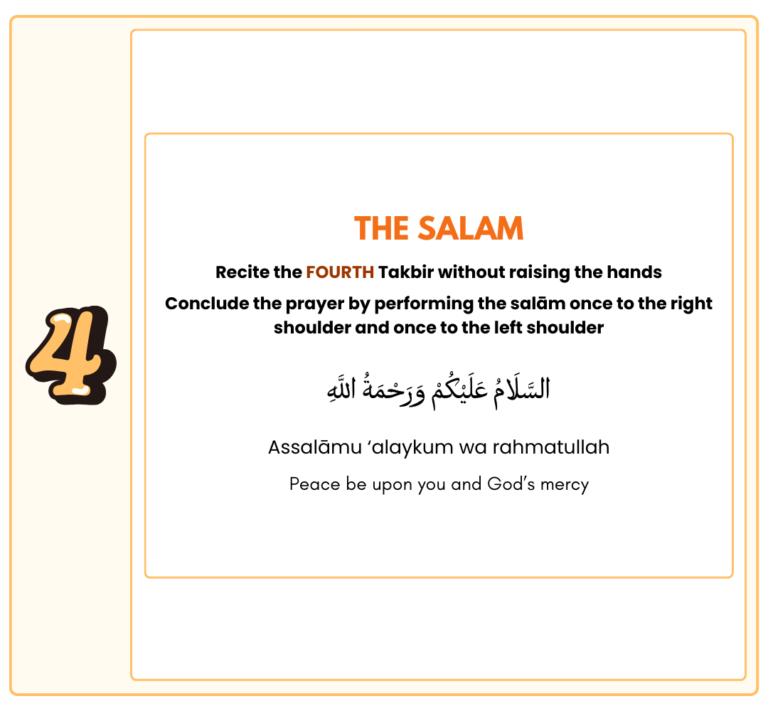
The Janāza prayer is the Islamic funeral prayer for a deceased Muslim. It is a simple, dignified act of worship, consisting of four takbīrs and prayers for Allāh’s forgiveness and mercy upon the deceased and to comfort their family. It is a communal obligation (fard kifāyah), reflecting the collective responsibility and compassion of the Muslim community.
INTENTION (NIYYAH)
Before commencing the prayer, form the intention in the heart to pray Salat al-Janaza, as a communal obligation, following the imam, and facing the qibla.
JANAZA FAQs
What is the importance and virtue of attending the funeral prayer?
The Islamic funeral prayer (salat al-janaza) is a communal obligation (fard kifaya). If some members fulfill it, the obligation is lifted from the rest. The Prophet ﷺ said that whoever attends the funeral prayer receives one qirat of reward, and whoever follows the procession until burial receives two qirats, each like Mount Uhud. He ﷺ also described following the funeral as one of the five rights a Muslim has over another.
Furthermore, the Messenger of Allah ﷺ said, “If a Muslim dies and forty people, who do not associate anything with Allah in worship, participate in the funeral prayer over him, Allah will accept their intercession for him.”
References:
Sahih al-Bukhari 1325; Sahih Muslim 945; Sahih al-Bukhari 1240; al-Nawawi, al-Majmu‘ 5:212, and Riyad as-Salihin 933.
What is recited after the first takbir in the funeral prayer?
After the first declaration (takbir) in the funeral prayer (salat al-janaza), the preferred recitation (according to the Hanafi school) is that one recites opening praise (thana), specifically the supplication beginning:
“Glory be to You, O Allah, and all praise is Yours…”
(Subhanaka Allahumma wa bihamdik…)
This is stated in authoritative Hanafi works such as al-Shurunbulali’s Nur al-Idah and al-Kasani’s Bada’i al-Sana’I and others. The reasoning is that the funeral prayer is fundamentally a supplicatory prayer (du‘a’) and does not contain bowing (ruku‘) or prostration (sujud), and therefore differs in structure from the standard ritual prayers.
At the same time, other respected Sunni jurists hold that reciting the Opening Chapter (al-fatiha) after the first takbir is sunnah. They cite the general statement of the Prophet ﷺ:
“There is no prayer for one who does not recite the Opening of the Book.”
(Bukhārī 756; Muslim 394)
Based on this evidence, scholars of the Shafi‘i and Hanbali schools consider recitation of al-fatiha in the funeral prayer to be legislated.
Both positions are rooted in valid juristic reasoning, and the difference reflects methodological distinctions regarding whether the funeral prayer is treated analogically as a full ritual prayer or as a distinct supplicatory rite.
References:
Al-Shurunbulali, Nur al-Idah; al-Kasani, Bada’i al-Sana’i; Sahih al-Bukhari 756; Sahih Muslim 394.
What if I do not know the supplication after the third takbir?
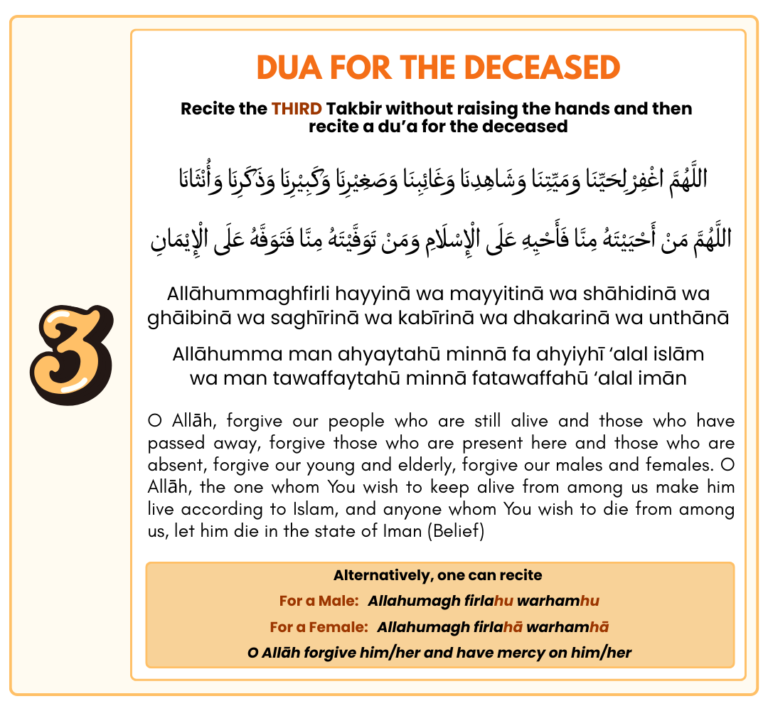
After the third takbir, one makes supplication for the deceased. Any sincere du‘a for forgiveness and mercy suffices. The Prophet ﷺ said: “When you pray over the deceased, make sincere supplication for him.” A commonly recited du’a (in lieu of the traditional salat al-janaza du’a) is:
For a Male:
اَللّٰهُمَّ اغْفِرْ لَهُ وَارْحَمْهُ
Allahummagh-fir lahu war-hamhu
For a Female:
اَللّٰهُمَّ اغْفِرْ لَهَا وَارْحَمْهَا
Allahummagh-fir laha war-hamha
Translation
“O Allah, forgive him/her and have mercy on him/her.”
References:
Sunan Abi Dawud 3199; Sahih Muslim 963.
Are the hands raised after each takbir?
The Hanafi position is that hands are raised only at the opening takbir. Ibn Umar raised his hands at each takbir, which is the position of the Shafi’i school. Imam al-Nawawi states both practices are valid.
The preferred position according to the Hanafi school is that the hands are raised only with the opening declaration (takbir) of the funeral prayer (salat al-janaza), and not with the subsequent takbiraat (pl. of “takbir”). After the first raising, the hands remain folded for the remainder of the prayer.¹
This is based on narrations indicating that the Prophet ﷺ raised his hands at the beginning of the funeral prayer, and the absence of consistently established reports that he continued to raise them with each subsequent takbir. The Hanafi jurists therefore limited raising the hands to the initial declaration, in accordance with their broader principles regarding raising the hands in prayer.
It is also reported that ʿAbdullah ibn ʿUmar (may Allah be pleased with him) would raise his hands with every takbir in the funeral prayer. Based on such narrations, many jurists of the Shafi‘i and Hanbali schools consider raising the hands at each takbir to be sunnah.
Imam al-Nawawi states that both practices are reported and valid.
References:
Al-Shurunbulali, Nur al-Idah; al-Bayhaqi, Sunan al-Kubra 4:44; al-Nawawi, al-Majmu‘ 5:222.
Is it permissible to perform the funeral prayer inside a mosque?
It is preferable that the funeral prayer (salat al-janaza) be performed outside the designated prayer space (musalla) when reasonably possible. This was more commonly the practice in the time of the Prophet ﷺ, and many jurists considered it superior due to the distinct nature of the funeral prayer as a communal supplication rather than a standard congregational ritual prayer.¹
However, when circumstances require — such as limited space, weather conditions, logistical considerations, or community needs — performing the funeral prayer inside the mosque is valid and permissible.
This permissibility is established by the report that the Prophet ﷺ prayed over Sayyiduna Suhayl ibn Bayda (may Allah be pleased with him) inside the mosque.
References:
Al-Kasani, Bada’i al-Sana’i; Sahih Muslim 973.
Can the funeral prayer be performed if the body is not present?
According to the Hanafi school, the funeral prayer in absentia (salat al-gha’ib) is not legislated. The presence of the deceased’s body is considered a condition for the validity of the funeral prayer.
Hanafi jurists interpret the Prophet’s ﷺ prayer in absentia over al-Najashi (the Negus of Abyssinia) as a unique circumstance specific to him. They explain that al-Najashi had no Muslims in his land to perform the funeral prayer over him, and thus the Prophet ﷺ prayed over him in Madinah as an exceptional case, not as a general precedent.
Other jurists, particularly in the Shafi‘i and Hanbali schools, understood this report as establishing the permissibility of the funeral prayer in absentia more generally.
Both positions are rooted in valid juristic reasoning.
References:
Al-Kasani, Bada’i al-Sana’i; Sahih al-Bukhari 1333; Sahih Muslim 951.
Can Muslims make supplication for non-Muslims?
It is permissible for Muslims to supplicate (du‘a’) for non-Muslims during their lifetime — particularly for their guidance, well-being, protection, and rectification. The Prophet ﷺ himself prayed for the guidance of those who opposed him, even while enduring harm at their hands.
Among the well-known examples is his supplication:
“O Allah, guide my people, for they do not know.”
He ﷺ also prayed for specific individuals to be guided to Islam.
However, once a person has died upon disbelief, it is not permissible to supplicate for their forgiveness. Allah Most High states:
“It is not befitting for the Prophet and those who believe to seek forgiveness for the polytheists, even if they were relatives, after it has become clear to them that they are companions of Hellfire.”
(Qur’an 9:113)
The jurists across the Sunni schools understood from these texts that supplication for guidance is permissible during life, but seeking forgiveness after death for one who died upon disbelief is not legislated.
References:
Sahih al-Bukhari 2937; Qur’an 9:113.
Is it permissible for women to attend funeral prayers or visit graves?
It is permissible for women to attend the funeral prayer (salat al-janaza). The permissibility of women attending funeral prayers is established by the absence of any authentic prohibition preventing them from participating in the prayer itself. The Prophet ﷺ said:
“Do not prevent the female servants of Allah from the mosques of Allah.” (Sahih Muslim)
Since the funeral prayer is a congregational act of worship, it falls within this general principle unless a specific prohibition exists.
With respect to visiting graves, there was an early prohibition in Islam. The Prophet ﷺ initially forbade grave visitation, as the community was newly emerging from pre-Islamic practices. However, this prohibition was later abrogated. He ﷺ said:
“I had forbidden you from visiting graves. Now visit them, for they remind you of the Hereafter.” (Sunan Ibn Majah)
The majority of Sunni jurists understood this abrogation to apply generally. While some scholars maintained discouragement for women due to concerns of excessive lamentation in earlier societies, many authoritative jurists held that women may visit graves provided proper decorum is observed.
Imam al-Nawawi states that visiting graves is permissible for women when done for the purpose of reflection and remembrance of death.
Accordingly, it is permissible (ja’iz) — and may be spiritually beneficial — for women to attend funeral prayers and visit graves for reflection, supplication, and remembrance of the Hereafter, provided modesty is maintained and no impermissible actions occur
References:
Sahih al-Bukhari 900; Sahih Muslim 442, 977; al-Nawawi, al-Majmu‘; Ibn Abidin, Radd al-Muhtar, and Sunan Ibn Mājah 1571
Are headstones permissible?
Yes. It is permissible to mark a grave with a simple stone or marker for the purpose of identification.
The Prophet ﷺ himself placed a stone at the grave of ʿUthman ibn Mazʿun (may Allah be pleased with him) so that he could recognize and locate the grave. This establishes the permissibility of marking graves so that family members and visitors may identify them.
At the same time, Islamic teachings emphasize simplicity in burial. The Prophet ﷺ prohibited excessive construction or embellishment over graves, and the jurists (i.e. Imam Nawawi and others) found it offensive to build elaborate structures with costly materials or decorative displays that transform graves into monuments. The purpose of a grave marker is simply to identify and locate the grave, not to serve as a display of status or wealth.
Scholars also discouraged inscribing verses of the Qur’an, the name of Allah, or the name of His messenger ﷺ upon grave markers. The reasoning is one of reverence: such sacred words should not be placed on the ground or be stepped upon, and it is not befitting that the loftiest names and revealed verses be placed in locations where they may be subjected to disrespect.
References:
Sunan Abi Dawud 3206; Sahih Muslim 970; Sharh Sahih Muslim v. 7, p. 1179
Is cremation permissible?
No, cremation is strictly prohibited in
Islam.
The Qur’an emphasizes that human beings are
created from the earth and are to be returned to it:
“From it We created you, into it We
shall return you, and from it We will extract you once again.” (Qur’an
20:55)
And
“Indeed, We have sanctified the children of
Adam…” (Qur’an 17:70)
Islamic law maintains that the sacredness (hurma)
of the human body remains after death just as it was during life. The deceased
must be treated with dignity, washed, shrouded, prayed over, and buried in the
earth. Cremation — which involves the deliberate burning of the human body —
violates this sanctity.
The Prophet ﷺ said: “Breaking
the bone of a deceased person is like breaking it while he is alive.”
(Sunan, Ibn Majah)
This hadith establishes that harm inflicted
upon the body after death carries the same moral weight as harm inflicted
during life.
Additionally, the Prophet ﷺ said:
“None punishes with fire except the Lord
of Fire.” (Sunan Abi Dawud)
Based on these texts, the jurists affirmed
that it is forbidden to burn anything endowed with a soul, and this prohibition
applies equally to one who instructs cremation in their final directives and to
those who carry it out.
Accordingly, burial in the earth is the
only legislated and permissible method of disposition for a deceased Muslim.
References:
Qur’an 20:55; Sunan Abi Dawud, no. 3202;
Ibn Majah, no. 1616; Sunan Abi Dawud, no. 2675; Musnad Ahmad, vol. 4, 147.
Is it permissible to pour water over a grave?
Yes. Pouring water over a newly buried grave is established in the hadith literature as something done by the Prophet ﷺ and the blessed companions. It was also found in the works of early jurists. The scholars understood this to be a sunnah action connected to burial rites.
The outward wisdom commonly mentioned by jurists is that water helps settle the soil and stabilize the freshly placed earth over the grave. However, the actions of the Prophet ﷺ are never devoid of benefit. They carry both outward and inward wisdom — though the deeper dimensions of that wisdom are not always explicitly stated in the texts.
Some later cultural claims suggested that pouring water over the grave was intended to “quench the thirst” of the deceased. However, Imam al-Nawawi explicitly dismissed this explanation, stating that there is no reliable textual basis for such a claim. The act is therefore affirmed on the basis of transmitted practice, not speculative reasoning.
References:
Ibn Abī Shayba, al-Muṣannaf, Kitāb al-Janāʾiz, vol. 3, 327; see also al-Bayhaqī, Sunan al-Kubrā, 4:56; al-Nawawī, al-Adhkār, discussion on burial practices.
Can Qur’an be recited at the cemetery?
Yes. The recitation of the Qur’an at the grave is permitted by the majority of Sunni jurists, and many considered it praiseworthy (mustahabb), particularly at the time of burial or during visitation.
It is authentically reported that ʿAbdullah ibn ʿUmar (may Allah be pleased with him and his father) instructed that when he was buried, the opening verses of Surat al-baqara be recited at his head and its concluding verses at his feet. This report is transmitted by al-Bayhaqi and cited by numerous jurists as evidence for the permissibility of recitation at the grave.
Based on such reports, Imam Ahmad permitted recitation at the grave, and this became an established view within the Hanbali school.
Ibn Taymiyyah likewise affirmed that reciting Qur’an and conveying its reward to the deceased is permissible. He explicitly stated that the deceased benefits from acts of worship performed on their behalf, including recitation, supplication, and charity.
Accordingly, reciting Qur’an at the cemetery and gifting its reward to the deceased was encouraged and affirmed by major jurists across the sunni tradition.
References:
Al-Bayhaqi, Sunan al-Kubra, vol. 4 (Beirut: Dar al-Kutub al-‘Ilmiyya, 2003), 56. Ibn Qudamah, al-Mughni, vol. 2 (Beirut: Dar al-Fikr, 1984), 424. Ahmad ibn Taymiyyah, Majmuʿ al-Fatawa, vol. 24 (Riyadh: Dar al-ʿAlam al-Kutub, 1995), 324, 366–367.
Can supplication be made after burial?
Yes. It is recommended to remain at the grave briefly after burial and make supplication (duʿaʾ) for the deceased.
It is authentically reported that whenever the Prophet ﷺ completed the burial of a deceased person, he would remain at the grave and instruct those present to supplicate for the deceased. He would say:
“Seek forgiveness for your brother and ask for firmness for him, for he is being questioned now.” (Sunan Abi Dawud)
This narration establishes the recommendation of making supplication immediately after burial, particularly asking Allah to grant the deceased steadfastness during the questioning in the grave.
The scholars understood from this hadith that remaining briefly after burial for the purpose of supplication is a sunnah practice.
References:
Sunan Abi Dawud 3221.
What is Talqin?
Talqin (literally, “prompting” or “reminding”) refers to the practice of addressing the deceased after burial, reminding them of the foundational tenets of faith. Traditionally, a learned person or family member stands at the head of the grave and calls the deceased by name, reminding them of the testimony of faith, the Oneness of Allah, and the Prophethood of Sayyiduna Muhammad ﷺ.
A narration attributed to the Prophet ﷺ states:
“When one of you dies and you have leveled the soil over his grave, let one of you stand at the head of his grave and say: ‘O so-and-so, son of so-and-so… Remember the covenant upon which you left this world: the testimony that there is no god but Allah and that Muhammad is the Messenger of Allah…’” (Al-Tabarani)
The chain of this narration has been debated among hadith scholars, with some classifying it as weak (da‘if). However, a number of jurists, including Imam al-Nawawi and Ibn al-Salah, permitted its use under the principle that weak hadith may be acted upon in matters of virtuous deeds (fada’il al-a‘mal), provided they do not establish new doctrine or contradict stronger evidence.
Additionally, Ibn ʿAsakir, in his monumental Tarikh Dimashq, reported that the practice of talqin was openly performed by a number of companions who later settled in Sham (Greater Syria), as well as by the Successors (Tabi‘un) there. This historical transmission strengthened its acceptance among later jurists in certain regions.
Accordingly, while the hadith basis is debated, the practice of talqin has been affirmed by many jurists as a permissible act of reminder and supplication following burial.
References:
Al-Tabarani, al-Muʿjam al-Kabir, vol. 8 (Cairo: Maktabat Ibn Taymiyyah, 1994), 249.
Yahya ibn Sharaf al-Nawawi, al-Adhkar (Beirut: Dar al-Fikr, n.d.), 168; Ibn al-Salah, Muqaddimah fi ʿUlum al-Hadith (Beirut: Dar al-Kutub al-‘Ilmiyya, 1986), 98.
Ibn ʿAsakir, Tarikh Dimashq, vol. 47 (Beirut: Dar al-Fikr, 1995), 496.
What are the etiquettes of attending the burial procession?
Attending a funeral procession carries both spiritual reward and moral responsibility. The following etiquettes are established through the Prophetic tradition and the understanding of the jurists:
• Maintain Quiet Reflection
One should maintain composure and reflect upon death and the Hereafter. The funeral procession is not a place for idle talk or laughter. The Prophet ﷺ said:
“Visit the graves, for they remind you of the hereafter” (Sahih Muslim)
The scholars understood that the same reflective posture applies during the procession itself. Loud discussions, taking non-urgent phone calls, and idle talk are discouraged.
• Walk with the Bier
It is recommended to accompany the funeral procession at a dignified, brisk pace. The Prophet ﷺ said:
“Hasten with the funeral…” (Sahih Bukhari)
The jurists state that one may walk in front of, behind, or beside the bier, as all positions have been reported from the companions (may Allah be pleased with them). It was also practice of the Prophet ﷺ to stand as the bier approached.
• Be in a State of Remembrance (Dhikr)
Engaging in remembrance of Allah (dhikr), recitation of Qur’an, and sending abundant blessings upon the Prophet ﷺ during the procession is praiseworthy, as it aligns with the solemnity of the moment. While there is no specific formula mandated, it remains consistent with the Qur’anic command:
“O you who believe, remember Allah with much remembrance.” (Qur’an 33:41)
• Carry the Bier
Participating in carrying the bier is virtuous and reflects communal solidarity. The Prophet ﷺ and his Companions were reported to have carried biers. The jurists recommend taking turns at the four corners.
• Offer Three Handfuls of Soil
It is reported that the Prophet ﷺ threw three handfuls of soil into the grave after burial. The jurists mention this as a sunnah practice symbolizing participation in the burial.
• Stay to Supplicate for Firmness
After burial, it is recommended to remain briefly and supplicate for the deceased. The Prophet ﷺ said:
“Seek forgiveness for your brother and ask for firmness for him, for he is being questioned now.” (Abi Dawud)
This establishes the sunnah of remaining momentarily after burial to pray for the deceased’s steadfastness during questioning.
References:
Sahih Muslim 977; Sahih al-Bukhari 1315; Sahih Muslim 944; Sahih Muslim 971; Sunan Ibn Majah 1565; Sunan Abi Dawud 3221.
What are some types of charity someone can do on behalf of the deceased that will benefit them?
Islam teaches that acts of charity and devotion can continue to benefit a person even after their passing. These are often described as ongoing charity (sadaqa jariya), which are acts whose benefit continues over time.
The Prophet ﷺ said:
“When the son of Adam dies, his deeds come to an end except for three: ongoing charity (sadaqa jariya), beneficial knowledge, or a righteous child who prays for him.” (Sahih Muslim)
Because of this principle, Muslims have long performed charitable acts on behalf of deceased loved ones with the intention that the reward be conveyed to them.
Examples of ongoing charity (sadaqa jariya) include:
• Sponsoring copies of the Qur’an so that people may read and benefit from them.
• Planting trees whose shade, fruit, and environmental benefits continue for years.
• Supporting education, to facilitate the acquisition and dissemination of beneficial knowledge.
In addition to ongoing charity, scholars have also affirmed that the reward of beneficial acts, even if they are not ongoing in nature, may be gifted to the deceased (isal al-thawab).
For example, Muslims may give charity on behalf of a loved one by:
• Sponsoring meals for those in need
• Supporting homeless shelters, community programs, or food distribution initiatives
The permissibility of giving charity on behalf of the deceased is established in the sunnah. A man once asked the Prophet ﷺ whether charity given on behalf of his deceased mother would benefit her, and the Prophet ﷺ replied: “Yes”(Sahih al-Bukhari)
Classical scholars across the Sunni tradition affirmed this principle. Imam al-Nawawi states that the scholars have consensus that charity on behalf of the deceased benefits them. Ibn Hajar likewise explains that acts of charity performed by the living may reach the deceased by Allah’s permission.
Hanafi jurists also affirmed this ruling. Ibn ʿAbidin writes that the reward of recitation, charity, and other good deeds may be conveyed to the deceased. Imam al-Suyuti also affirmed that various good deeds performed by the living may benefit those who have passed away.
For this reason, Muslims throughout history have honored their parents and loved ones by performing acts of charity in their name, with the hope that these acts of goodness bring them relief, continued reward and mercy in the Hereafter.
Both ongoing charity (sadaqa jariya) and gifting rewards to the deceased (isal al-thawab) are considered ‘legacy giving’ and are excellent ways to honour someone beloved to you.
Looking for meaningful ways to benefit the deceased?
https://eternalvirtue.org/legacybundles/
References
- Ṣaḥīḥ Muslim, no. 1631. Ṣaḥīḥ al-Bukhārī, no. 1388; Ṣaḥīḥ Muslim, no. 1004. Al-Nawawī, Sharḥ Ṣaḥīḥ Muslim, commentary on charity for the deceased . Ibn Ḥajar al-ʿAsqalānī, Fatḥ al-Bārī, commentary on Ṣaḥīḥ al-Bukhārī 1388. Ibn ʿĀbidīn, Radd al-Muḥtār, vol. 2. Al-Kāsānī, Badāʾiʿ al-Ṣanāʾiʿ, vol. 2. Al-Suyūṭī, Sharḥ al-Ṣudūr bi-Sharḥ Ḥāl al-Mawtā wa-l-Qubūr.